Founders often spend six months and thousands of dollars chasing a technical co-founder who does not exist. This delay allows competitors to capture the market first while the original product idea sits in a slideshow. Moving from a concept to a scalable software product requires a different path, such as the Product & Venture Studio model.
Ready to launch your MVP? Book a Discovery Call with our team today →
A venture studio is a partner that provides the technical talent and business resources to turn a concept into a successful product. According to studies by the UNHInnovation Venture Studio, this model creates a central setup to reduce waste and help you launch faster. Instead of just giving advice, these studios bring full engineering teams directly into your business to build your first product. This close partnership allows early-stage startups to bypass slow hiring cycles and launch their apps with great speed. We help you test your product with real users and build a highly scalable technical system from day one. By sharing the daily work, this partnership lowers development risks and helps you establish a solid foundation for growth.
To build a successful startup, you must first understand how this collaborative setup compares to traditional accelerators or incubators. Learning What Is a Venture Studio and How Does It Differ from Other Models? helps you choose the right path. Let us examine:
What Is a Venture Studio and How Does It Differ from Other Models?
A venture studio is a firm that builds new startups from the ground up by acting as an active co-founder. Unlike venture capital firms that provide funding with quarterly check-ins, a venture studio supplies daily hands-on engineering, product design. And business resources to take a concept from ideation through MVP and beyond, typically taking 30% to 50% equity in exchange for full-stack execution.
A venture studio is a firm that builds new startups from the ground up. It does not just invest money or offer space. It acts as an active co-founder, putting its own team, tech, and tools into the new company. This model has grown fast because it helps founders turn raw ideas into real software with much less risk.
The Rise of the Venture Studio Model
The roots of this model go back to the launch of Idealab in 1996, which created over 75 companies. Since then, the space has seen rapid growth. Reports show about a 5,000% growth in the studio sector since 2013, as more builders seek hands-on help. Founders choose this path because they need speed and strong tech skills from day one.
This growth is fueled by a clear market need. In the past, founders had to raise pre-seed capital and spend months hiring developers. Now, the studio approach bypasses that slow path. This model acts as an engine that matches top engineers with vetted startup ideas, which cuts time to market by more than half.
How Studios Compare to VCs and Accelerators
To understand how a venture studio works, it helps to contrast it with older startup paths. Many builders mix up studios with venture capital (VC) firms, incubators, or accelerators. But their core support, equity terms, and day-to-day work are very different. Academic research from an MIT thesis shows that studios reduce failure rates by using shared resources across multiple early-stage projects.
| Model | Core Focus | Work Involvement | Stage | Equity Asked |
|---|---|---|---|---|
| Venture Studio | Co-builds the product from scratch | Daily hands-on tech and product design | Ideation to MVP | High (30% to 50%) |
| Traditional VC | Offers funding and board guidance | Monthly or quarterly check-ins only | Growth to scale | Low (10% to 20%) |
| Incubator | Provides desk space and basic mentoring | Optional networking and ad-hoc advice | Early concept | Minimal (0% to 10%) |
| Accelerator | Runs cohort programs to scale | Weekly workshops and pitch prep | Post-MVP launch | Mid (5% to 10%) |
As shown in the table, the trade-off is often about equity versus daily support. While VC firms take less equity, they offer limited hands-on help. A venture studio takes a larger stake but provides the full product team you need to launch. This makes a venture studio a strong match for early-stage founders who need a technical co-founder but cannot find one.
The Founder's Dilemma: Why Finding a Technical Co-Founder Is So Hard
Most early-stage founders cannot find a quality technical co-founder because top engineers rarely leave stable jobs to join an unproven startup. This talent gap causes delays of six months or more while competitors gain market share. A venture studio solves this problem by providing a full engineering team immediately, eliminating the need to find, vet, and convince a co-founder to join.
A venture studio is built to solve the technical co-founder problem. Many founders have a strong business plan but no one to lead the technical build. Finding a qualified partner takes months, and most searches fail. This gap causes over half of all early-stage startups to fail before they launch anything. The product idea stays stuck in a slide deck while the market moves on.
Even founders who find a technical co-founder face major hurdles. They must divide equity early, often giving up 40% to 60% of the company for technical leadership. They also risk co-founder conflict that can sink the venture. A venture studio removes these risks by acting as your dedicated engineering partner from day one. The studio provides the technical execution while you retain control of your business strategy and vision. This is why many smart founders choose a venture studio to increase their odds of long-term success.
How Teravision's Venture Studio Approach Changes the Game
Teravision's Venture & Product Studio provides founders with a full engineering team in two weeks, not six to ten. Our nearshore model places developers in the same time zone (EST/CST) for real-time collaboration. With over 20 years of experience, 400+ clients, and a 95% retention rate, we deliver partner-level engagement with month-to-month flexibility and no long-term contracts.
Every founder needs someone who can lead development and manage early risks. Research from the UNH Innovation Venture Studio shows that studios help founders build market-ready products.
They give founders vital support to reduce risk. This model solves the talent gap. Instead of hiring one person, you get a full product team. This team starts scaling your software product right away.
We act as your dedicated engineering partner. We do not just write code for a fee. We give partner-level engagement to your leadership team. Our goals align with your success.
This partnership ensures we build the right software for your market. We work with you to plan your roadmap and define your MVP. Working together keeps your project on track and within budget. For startups that need more than project-based help, our staff augmentation model provides flexible team scaling as your product grows.
Proven Heritage and Nearshore Execution
Our team brings over 20 years of product heritage to your startup. We have served over 400 clients and delivered 1000 projects. This deep knowledge helps us avoid common software mistakes.
We use our proven nearshore model to build your team in the same time zone. This setup means we work in EST and CST to talk in real time. Our clients stay with us because they trust our work. We have a client retention rate of over 95 percent. The benefits of nearshore development go beyond cost savings to include deep cultural alignment and English fluency.
Hiring local developers takes too much time. The standard hiring process takes six to ten weeks. Our nearshore model speeds up this process. We offer a rapid two-week ramp-up time for new teams.
This speed helps you start building your software fast. You do not have to wait for months to begin development. Our month-to-month terms give you great freedom. You can scale your team up or down with no long-term contracts.
The Four Stages of Partnership
We guide founders through a structured path to turn their ideas into successful businesses. Our Product & Venture Studio model uses four clear stages.
Each stage has a specific focus. This system helps us build high-quality products with low risk. We work closely with you through every step of this journey.
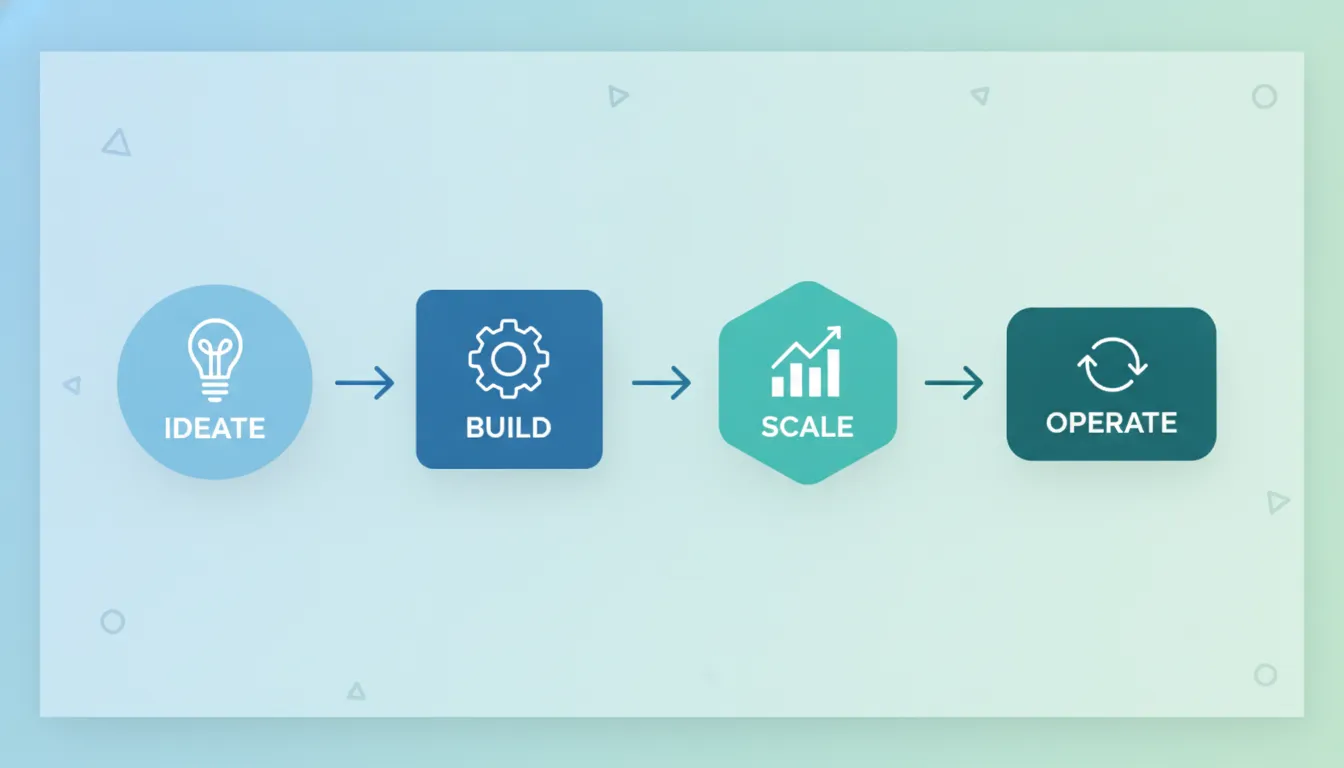
- Ideate. We help you refine your product concept. We use our business skill and technical knowledge to validate your idea and plan your features. This step ensures you build something that solves real user problems.
- Build. Our engineering team builds your minimum viable product. We use advanced development practices to deliver clean and reliable software. This rapid process gets your product to market quickly.
- Scale. We help you grow your product as your user base expands. Our team adds new features and improves system performance. This support helps your software handle more traffic without slowing down.
- Operate. We maintain and manage your software platform over time. Our engineers monitor your systems to prevent downtime and fix bugs. This service gives you peace of mind so you can focus on business growth.
This structured process removes the risk of starting a new venture. Our studio acts as your technical co-founder. We stay by your side through each stage of growth.
You get the benefit of a seasoned engineering team without the high cost of local hiring. This partnership lets you focus on finding customers and growing your brand.
From Idea to Validated Concept: The Venture Studio Ideate Stage
The ideate stage uses a problem-first approach backed by AI-driven market research to validate your product concept before any code is written. We analyze market trends, competitor gaps, and user pain points in days, not months. Rapid prototyping and user feedback help us refine the product vision so the eventual MVP solves a real, paying problem from day one.
Every product begins with a spark, but a raw idea is not yet a business. In our four-stage model, we start with the ideate phase. This phase uses a problem-first approach to make sure your solution has a real market.
We help you look past early hope to find real market needs. A venture studio provides the needed tools, guidance, and resources to turn these early ideas into market-ready concepts. By testing early ideas fast, we help you avoid building something nobody wants. This early work sets the stage for a product that can grow.
AI-driven market discovery
To test a concept, we use AI-powered tools for deep market research. Old research can take months, but our tech-driven approach cuts that time down. We study market trends, look at rival gaps, and find user pain points in days. This rapid research is part of our business model design. Our AI-powered teams bring advanced data analysis capabilities to speed up the discovery process.
Many studios use structured processes for market discovery to guide early business planning. This ensures we do not just build a product, but we build a strong business around it. Through this problem-first approach, we clarify what the product must do. By doing this early work, we help founders achieve a 3 to 5 times faster go-to-market rate.
Rapid concept validation
Once we define the problem, we create rapid prototypes to test the solution. We do not write complex code yet. Instead, we build simple wireframes and mockups to show the product flow. This allows us to gather user feedback without high costs.
This process is key before building an MVP because it proves the core loop. By getting feedback early, we make sure the MVP will solve the right problem from day one. Our design work also aims at cutting risk for the entire venture.
We look at technical hurdles and find ways to solve them early. This helps us plan the exact skills your team will need. It saves time and stops costly changes during the build phase. You get a clear roadmap that shows clearly how your product will work and scale.
Problem-first product definition
We believe a great product must start with a real problem. Many founders focus on features first and lose sight of the user. We turn this around by using a problem-first approach. We talk to likely users and study their daily work to find their deepest pain points.
This focus ensures that your concept targets a gap in the market that people are willing to pay to solve. Our product plans evolve as we collect this data. We refine the core features and outline the user flow. This careful planning helps us align your product with business goals.
It creates a solid base before any coding work begins. In this way, our studio helps you build a proven concept with a clear path to success.
Building Your MVP with Speed and Precision: The Venture Studio Build Stage
The build stage converts your validated concept into a working software product using agile sprint cycles, AI-assisted coding, and continuous QA testing. Our nearshore engineering teams ramp up in two weeks and work in EST/CST time zones for real-time collaboration. The result is a market-ready MVP built with clean, scalable code that can handle real user traffic from day one.
The build stage is where your ideas become a real software product. In a modern venture studio, this phase is built for pure speed and high quality. We do not waste time on long setups or slow plans. Instead, we use proven tools to turn your concept into a working app so you can launch fast, test with real users, and start growing.
Setting Up the Engineering Team
Starting the build phase needs the right set of skills. In most tech firms, hiring a full team takes six to ten weeks, but our nearshore venture studio model cuts this delay down. We offer a fast two-week ramp-up time to get your product team running right away. This team joins your work group to keep your path clear and smooth while fitting your exact needs. Our product engineering services are designed to integrate seamlessly with your existing workflows.
When you are building an MVP, every week counts. Our teams work in EST and CST time zones to build side-by-side with your leaders. This close match avoids the lag of offshore teams, giving you daily updates and quick feedback. This setup ensures that we build your product with exact care and zero wasted effort.
Our Step-by-Step MVP Build Process
We use a clear path to take your product from a draft to a live launch. Our team follows these steps to make sure your app is robust and easy to scale.
- Design and System Architecture: We map out the data flows and build the basic system design. This step ensures the software has a strong base to grow on.
- Agile Sprint Cycles: Our team builds the app in two-week cycles to show quick progress. You see new features added to the tool at the end of each sprint.
- AI-Ready Code: We use modern AI tools to write clean code and build features at a fast pace. This method keeps our development speed high.
- Constant QA Testing: Our testers check every line of code to find and fix bugs early. This step ensures a stable tool for your users.
- Launch and Deploy: We set up the cloud servers and launch your product to the market. We check the live app to keep it running well.
Product Quality and Build Speed
Our focus is on raw technical speed and solid code. Academic hubs like the UNHInnovation Venture Studio offer resources to help founders turn ideas into products. In contrast, our nearshore model focuses on rapid software building to achieve a 3-5x faster go-to-market. This keeps your burn rate low and your build speed high.
With seamless integration, our developers join your work group as a single unit. There are no handoff issues or missed details. We mix agile delivery with constant testing to make sure the final product is secure and ready for real traffic. This ensures you launch with full confidence. Building a cross-functional product development team with nearshore talent gives you the speed and flexibility that traditional hiring cannot match.
Beyond the MVP: Scaling Your Product with a Venture Studio
Scaling an MVP requires shifting focus from initial launch features to system stability, performance optimization, and team expansion. A venture studio provides ongoing engineering support to handle growing user traffic, integrates AI automation to speed up development, and offers flexible team scaling through nearshore talent. This phase keeps your product competitive as your user base and feature set grow.
Launching an MVP is just the first step. To grow, you must shift your focus from initial testing to scaling. This shift requires stable systems and a clear roadmap for your software. A strong partner can help you build these systems without high costs or risks.
Shifting from Launch to Scale
Scaling a product means growing your user base while keeping your systems fast and stable. During this phase, you must focus on your core product goals. Research from the UNHInnovation Venture Studio shows that studios reduce waste by giving founders shared business services. These tools help you grow your product in a steady way.
As your startup grows, your internal team needs to expand quickly to handle new features. Finding and hiring top developers in the US often takes several months. You can avoid these delays by working with nearshore engineering teams for startups. This approach lets you scale up or down based on your active needs.
AI Automation and Better Workflows
Long-term growth is not just about adding more people to your team, but making your workflows fast and smooth. We help you set up AI tools to automate routine tasks and speed up your development. Our engineers are trained to integrate these AI frameworks into your daily work. This helps you build new features up to three to five times faster. As AI transforms software development teams, staying ahead of these changes gives your startup a competitive edge.
We also focus on steady updates to make your product better after launch instead of walking away. Our team monitors your software, fixes bugs, and improves performance every month. This ongoing support keeps your product stable as your user base grows. It also ensures you can adapt to market changes without starting over from scratch.
Our Track Record for Growth
Scaling a product requires deep skill and a proven process, which is why we bring over 20 years of product history to every client. We have delivered more than 1000 projects to over 400 clients. Our focus on close ties has led to a client retention rate of over 95 percent. This track record shows our ability to deliver real product growth.
Our clients include well-known brands like McDonald's, Live Nation, UNICEF, and Versapay. We offer a free discovery call to discuss your product needs. You can define the scope of the work and set clear milestones. Our goal is to help you build a successful product that users love.
Frequently Asked Questions About Venture Studios
What is a venture studio?
A venture studio is a company that builds new startups from scratch by providing hands-on engineering, product design, and business resources. Unlike VC firms that mainly provide funding, a venture studio acts as an active co-founder that builds the actual product alongside the founding team.
How is a venture studio different from an accelerator?
An accelerator runs cohort-based programs with weekly workshops and pitch preparation over a fixed period, typically taking 5-10% equity. A venture studio provides daily hands-on technical execution and product development, taking higher equity (30-50%) but delivering a fully built product rather than just mentorship and connections.
How much equity does a venture studio typically take?
Venture studios typically take 30% to 50% equity in exchange for providing the full engineering team, product design, and business resources needed to build and launch the product. This is higher than VC funding (10-20%) or accelerators (5-10%), but the studio also provides far more hands-on support and technical execution.
How long does it take to build an MVP with a venture studio?
With a venture studio like Teravision, the engineering team can be ramped up in just two weeks, compared to the industry standard of six to ten weeks. MVP build time depends on the product scope, but the studio model typically achieves 3-5x faster go-to-market compared to traditional hiring and development approaches.
When should a founder choose a venture studio instead of hiring a CTO?
A founder should choose a venture studio when they cannot find a quality technical co-founder within a reasonable time frame. Need to launch quickly to capture market share, or want to avoid the risk of co-founder conflict. The studio model provides a full engineering team immediately with month-to-month flexibility and no long-term commitments.
Ready to Turn Your Idea into a Scalable Product?
You have a validated concept and a clear market opportunity. What you need now is the engineering execution to bring it to life before your competitors capture the space. Teravision's Venture & Product Studio provides the technical co-founder support, rapid prototyping, and full-stack engineering team you need to go from idea to market-ready product.
Our nearshore model puts experienced engineers in your time zone within two weeks, with month-to-month terms that let you scale as your product grows. With over 20 years of experience and 400+ successful projects, we have the track record to de-risk your venture.
Book Your Free Discovery Call Today →
Call us at (888) 889-8324 to discuss your product vision.